
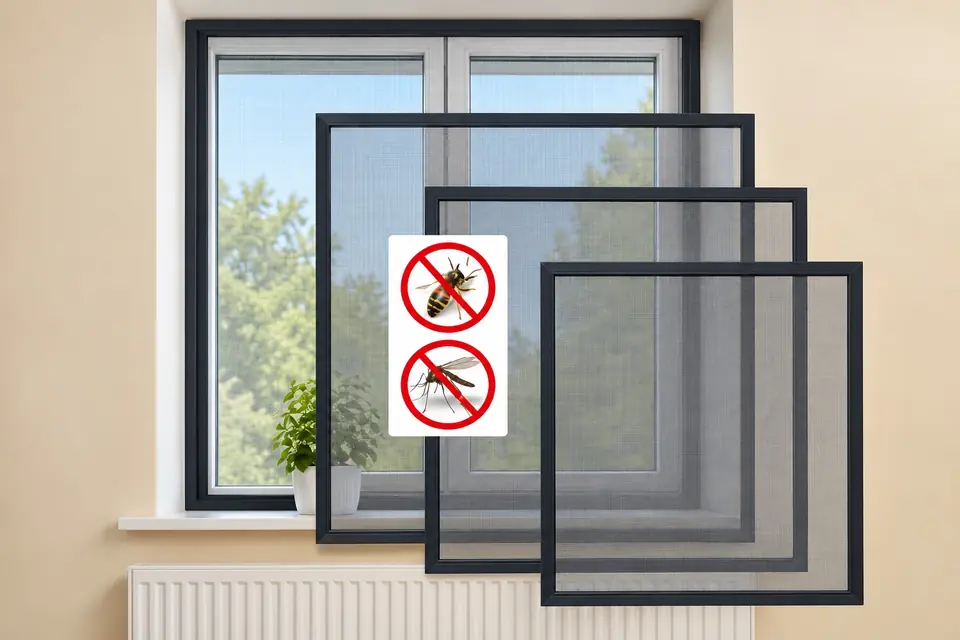
Compare the six builder options
What each mesh is designed to do
Charcoal fiberglass
The standard insect screen for good visibility and airflow. It suits most Houston windows and keeps mosquitoes outside without making the view feel heavy.
Grey fiberglass
The same everyday screen in a lighter color. It is useful when matching older grey screens, though dust and pollen can become visible sooner.
Heavy-duty charcoal
A thicker fiberglass mesh for windows that get more handling. It lasts longer but lets through a little less air and light than standard mesh.
Pet-resistant
A tougher mesh for cats and dogs that push or scratch at screens. It is heavier and darker than standard fiberglass.
No-See-Um
A tight weave for gnats and very small insects. The finer weave reduces airflow more than standard insect mesh.
Solar 80
A dense exterior mesh for strong west- and south-facing sun, glare and daytime privacy. It is darker and allows less airflow than insect screen.
Side-by-side
Window screen mesh comparison
| Mesh | Main benefit | Trade-off | Best fit |
|---|---|---|---|
| Charcoal fiberglass | Everyday insect control | Good airflow and visibility | Most Houston windows |
| Grey fiberglass | Light-color matching | Shows dust sooner | Matching older screens |
| Heavy-duty charcoal | Longer wear | Slightly less airflow and light | High-use windows |
| Pet-resistant | Claw resistance | Heavier and darker | Homes with pets |
| No-See-Um | Tiny-insect control | Tighter weave reduces airflow | Gnats and very small insects |
| Solar 80 | Sun and glare control | Darker view and less airflow | West- and south-facing windows |
Houston conditions
Mosquitoes, pets, pollen and west-facing sun
Start with the problem the window faces most often. Standard charcoal handles everyday mosquitoes. Pet-resistant mesh helps at low windows near animals. No-See-Um mesh targets tiny insects. Solar 80 belongs on the windows that receive the strongest afternoon sun.
Pollen collects on every mesh type, so seasonal cleaning still matters. Denser meshes take a little more care because they have smaller openings.
Specialty mesh can also go into a frame you already own. See window screen repair.
Explore custom window screens or read the Houston solar screen guide.
Built to your measurements
Ready to see your price?
Build your screen online, review every choice, and see the price before checkout.
Use a simple decision order
Choose protection first, then accept the trade-off
Begin with the most important problem. If it is everyday mosquitoes and airflow, standard charcoal is usually the starting point. If it is claws, choose pet-resistant. If very small insects pass through standard mesh, compare No-See-Um. If glare and strong afternoon sun matter most, consider Solar 80.
Next, decide what you are willing to trade. Denser mesh uses more material across the opening. That can improve durability, tiny-insect control or sun reduction, but it also reduces some airflow, light and outward visibility. Paying for the strongest mesh on every opening is not automatically the best plan.
Finally, consider how the windows are used. A rarely opened upper window may not need the same material as a patio-facing window near pets. The builder allows each screen to carry its own mesh choice.
Match mesh to the room
A room-by-room way to plan
Bedrooms
Prioritize insect control, airflow and a clear outward view. Standard charcoal works for many rooms.
Living areas
Consider pets, high traffic and large screen sizes. Heavy-duty or pet mesh may justify the darker appearance.
Kitchen and bath
Airflow matters. Choose a tighter weave only when tiny insects are a recurring problem.
Home office
West-facing glare may make Solar 80 useful, especially where a monitor sits near the window.
Children’s rooms
Mesh is not a fall-prevention device. Use proper window guards and supervision where safety is a concern.
Rental properties
Standardize where possible, but measure and specify each window rather than assuming one universal screen.
Visibility and airflow
Why a sample view can help
Mesh color, strand thickness and weave density all change how a screen looks. Dark charcoal often appears less noticeable when you look through it because the eye focuses beyond the mesh. Grey can match older screens but may remain more visible in some light.
Heavy-duty, pet-resistant, No-See-Um and solar meshes progressively place more material in the opening for a specific benefit. Stand inside and outside a similar screened window before choosing a specialty material for an entire elevation. When appearance matters to an HOA, confirm both mesh and frame color.
Airflow depends on wind, window type and how much open area the mesh provides. No screen manufacturer can promise that two different rooms will feel the same. Use the comparison table as a relative guide, not a performance guarantee.
Cleaning and service life
Care for the mesh you choose
Dust and pollen reduce airflow when they collect on screen fibers. Remove screens carefully, label their windows and rinse with low pressure. Mild soap and a soft brush or sponge are enough for most buildup. Rinse thoroughly and let the screen dry before reinstalling.
Do not use a pressure washer, sharp scraper or stiff wire brush. Support the frame instead of lifting it by a pull tab. Inspect spline, corners and hardware during cleaning; a loose edge is easier to correct before the mesh tears.
Service life depends on sun exposure, pets, tree contact, storms, handling and cleaning. Specialty mesh can address one source of wear, but correct fit and careful installation still matter.
Helpful details
Window screen mesh FAQ
Which mesh is best for mosquitoes?
Standard charcoal fiberglass works for common mosquitoes when the screen fits correctly and has no gaps.
What is best for very small gnats?
No-See-Um mesh uses a tighter weave, with some reduction in airflow and light.
Is pet-resistant mesh pet-proof?
No mesh is indestructible, but pet-resistant material stands up to claws better than standard fiberglass.
Can every window use Solar 80?
Many can, but the size, frame and mounting method still have to suit the opening. Check HOA rules before ordering.
Can I choose different mesh in one order?
Yes. Each configured screen can have its own dimensions, frame and mesh.
The default is useful for a reason
When standard charcoal is enough
Standard charcoal fiberglass remains the practical choice for many Houston windows. It offers insect control, a familiar appearance, good ventilation and the lowest starting price. Choose a specialty mesh only when a specific problem—pets, tiny insects, heavier use or direct sun—justifies its added density and cost.
If you are uncertain, order one representative screen first or ask TruShine to compare the room, exposure and window use. A targeted upgrade often works better than placing the heaviest mesh on every opening.
Built to your measurements
Ready to see your price?
Build your screen online, review every choice, and see the price before checkout.